Friday, August 28, 2009

Flower Power


I started this QU course last weekend. As usual Susan Brittingham gives full notes about all the processes and good illustrations. The homework for week one was to try free cutting for an applique flower. I wanted to do a rose that I had traced over, since I had the right fabric for it, and thought it was reasonably straightforward. I traced the b and w drawing onto freezer paper and numbered and labelled all the small pieces. I had a piece of fabric that was stripes of rust to tan all merging into one another. One end of it was dark reddish brown. The only other fabric I needed was a deep yellow, and a touch of lime yellow. All fabrics were solids, but it didn't matter for this project, which is small - less than journal size.

I spent all afternoon at the ironing board, cutting sticking the pieces for each petal separately first, and then assembling. Pretty well worked out which pieces needed to underlap - only two places I had to adjust. I got back ache, but keept going in the zone, and totally forgot the time. I looked at the clock at 5.55, thinking I was hungry and what would I have to eat, when remembered that I was going to a cooking class and needed to meet my friend at 6!

When I got home from learning how to make slow roasted lamb in pomegranate molasses and spices, with saffron pilaf, and rosewater panna cotta, I fused the whole rose to a piece of purple McKenna Ryan fabric. It looks pretty real.

I am not sure if I want to finish it, by stitching and quilting etc. No hurry, as I must finish my flower shop first.

Thursday, August 20, 2009

Movies, opera and sketching

Art quilt-wise, at the moment I am working on my house for the slice quilt our online group is doing. It is harder to keep going than I imagined. That might be partly because we let the timescale drift a bit. I did numerous samples for the windows, and I wanted to include something you could see through the glass, like a cat, a blind, or a vase. But the scale is so small, that I abandoned that idea. Next I tried several methods, upside-down applique, piecing and fusing. I preferred the fusing, because the UDA distorted the corners the most, and the piecing gave too much bulk. Would probably be fine on a larger item.

At the moment I am doing the decorative relief plaster that is on my sample photo of a large building on the waterfront in Willemstad, Curacao. I will do the flower shop part separately and attach it at the end, in case of disasters. I have some great fabrics with flowers on, which I hope I can fussy cut. When I get my embellisher back tomorrow I will also try attaching some using that. Oh my god - MORE samples!

Despite my best intentions of starting stitching at 8.30 this morning, I have passed a couple of hours looking at a DVD I rented of Fitzcarraldo. I saw this Werner Herzog movie years ago, and it had a huge impression on me. Since my boss is going to Manaus in a few weeks, I looked for it to check out my memory. Instead of watching the movie, I watched the interview with Herzog et al on the making of the movie. Honestly you get to see all the pivotal parts of the story, plus his tales of the making of it are actually more amazing than the original story. If you don't know the story, a manic Irish guy in Peru decides to build an opera house in the jungle, and that involves dragging a steamboat over a mountain to a different tributary of the Amazon. To make the movie, it took them 3 years to build two identical boats, one to drag and the other to sail about. Their camp, which took a year to build, was razed to the ground by hostile natives. Money was a constant worry and only came in dribs and drabs. Everyone though Herzog was crazy and it would never happen. There was only radio contact from the filming site to Iquito, and all supplies had to be brought from there. They used native Indians from logging areas to act and actually drag the boat (using winches and stone age wooden cranks). They used dynamite to try to improve the gradient from 60 degrees to 40 (plus a caterpillar machine that they shipped in). Half the time there was a drought and no water in the rivers, and the rest of the time there was too much. In the final scenes where the boat goes through rapids and gets damaged, they actually sent the boat through twice, once with a few people on, and once with none. They had to carry with them a few ladies of the night, to avoid problems with the crew and cast having to spend 8 months in the jungle. They had tense relations with the native Indians as it was, without incursions into their villages looking for women. There were lots of near accidents, and a few actual ones. One Indian got bitten by a very poisonous snake, and not having time to get to the antiserum, and knowing his heart would fail in less than 3 minutes, he cut off his own foot with a chainsaw! He survived. Kinski, the lead actor, was almost impossible to work with, having serious tantrums every day. He was certainly mentally unstable, which made him perfect for the part of Fitzcarraldo.

The interview was one of the most interesting I have ever listened to.

A lot of it was shot as in nighttime, with low level light, which had amazing effects. The native Indians have very prominent bone structure and I tried to sketch one man, who was wearing a headband with a few blue and orange bird feathers incorporated into it. Their faces would be great for a portrait quilt.

Now, it really is time to stitch!

Saturday, August 1, 2009

Stitching to dye


I bought June Barnes' book when I was in the UK (well it was my birthday present from my Mum, but I ordered it!). I have read it from cover to cover at least 3 times already, and I was excited to get to start playing with her ideas.

Her initial colour and dyeing exercises are based on blocks like logcabin or stars, since the focus is on the effects of different fabrics' take-up of colour. I couldn't think of a project where I wanted to do that, but I was experimenting with bark effects on trees, so I thought I could base my first attempt round that idea. I played with rectangular and random wavy blotches, and went for the semi-abstract rectangles and triangles, with a selection of natural coloured and printed fabrics. I bought several new FQs and some white on white ones, at Spotlight on Monday. I was very diligent and washed them all first. I also had some velvet for dyeing that I bought from marjie McWilliams, but I can't remember the composition of it now.

I did straight stitch round each scrap, though maybe I could leave out that step if I used glue or fusible web. Actually it took quite a long time. I was using the walking foot and swivelling at corners. I tried FMQ, but I didn't like the effect. Next I tried her granite stitch to secure the raw edges. I don't think I did them anywhere near small enough, but will play some more. I filled in the gaps with more circles and a few wavy lines. My impression is that the stitching and especially the garnet stitching makes too much of the gaps and detracts from the fabric patches.

I was supposed to be using cotton thread, but I only had cheapo white, with no writing on it, so couldn't tell. The blob test was inconclusive. Transpires now that most of it was cottonish, but when that ran out, I used polyester, which didn't take up the dye.

I mixed what I thought would be a yellow-green, but it turned out apple green. Looks OK. the velvet took the brightest dye, the linen the most yellow, and the attached calico the darkest bluest green. The neutral printed fabrics all turned out much the same colour.

I thought about colouring the threads with paint or crayons. Tried out 3 inktense colours on the back, but they migrated right through to the top overnight. I think the batting was the cotton and bamboo one. Nothin remarkable there, except the price.

I might use it to try low immersion dyeing and overdye with a turquoise, or I might start a new one with the white on whites. I had fun, and it didn't matter what happened, which was a good outcome.

Wednesday, July 22, 2009

Why I have been so quiet


Since halfway through my vacation, I have not been in the right headspace to post here. Once I got back from the UK and Japan, I was determined to finish the bed quilt I had started in 2001. It was a BOM from Quilter's Barn, Renwick. It began a month before I left to live in Italy for 8 months. I took all the fabric with me, and my cutting wheel and mat. I didn't have a sewing machine there.

Living in Italy was a bit strange. It was less than a year since I had split from my husband, and I wasn't sure what to do next, or where to do it. I went to live in Brescia, which is between Milan and Verona. The first couple of weeks were horrible, living in a dirty flat run by a strange taciturn man - arranged through the school, Inlingua, that I was working for. After that I got a fairly expensive room in a flat on the edge of the central area of town. My landlady/flatmate was from Argentina, and spoke no English. Maria was fairly garulous and most of our conversations consisted of her rattling away and me interjecting the occasional 'si, e vero'. I didn't particularly enjoy the work or the firm. Most of the time I was teaching business English to individuals or groups of 2 or 3. Inlingua has its own textbooks and method, which didn't leave a lot of room for developing your own resources. I was not that experienced at teaching, but I did know that modern methodology for language speaking means the teacher should not talk more than the student. Yet, the most popular teachers were egomaniac guys with lots of stories to tell!

I enjoyed Italy, I enjoyed living in a historic city that was not on the main tourist thoroughfare. It was magic to be able to cycle (no helmet required, hairstyles far more important than brain damage) into the centre and listen to openair concerts, recitals, circus performances, all in balmy summer evenings. Daytimes were very hot by May through to September, with frequent afternoon thunderstorms. The flat was in the mansard roof, good, as it had a roof garden, bad, as hot air rises. Below us was a pizzeria that made fabulous prawn and rocket pizzas. During the afternoons I often had 3 hours to fill in between lunchtime lessons and after-work lessons. I tried to cut out the triangles and squares for the quilt, but it was hot work.


Finally I completed the central section of the quilt, the landscape, with appliqued grapevines round the outside. I didn't have much experience of quilting large things, but I knew that the central portion would be quite tricky to reach. So I quilted that centre section while it was still manageable. That might have been in 2002. At various other times in the next 3 years I made the rest of the blocks for the quilt and the borders and added them to the quilt top. Even later I added more backing fabric and batting and tacked it all together. I stitched round a couple of borders to keep it from shifting and put it in the UFO box.

Finally, in about March I got it out and determined to finish it. I almost did it before I went to England this time, but in fact there was more to do than I thought. After I had done the meandering and some of the block joins with a gold patterned stitch, I thought I only had a couple of things to do. But I found I had to machine the stems of the vines, which I had hand stitched. Then after the meandering the central area was a bit puffy and I had to add some stitching to that.

I pinned it to the carpet and steamed it square yesterday and pronounced it finished.

Sure the satin stitch from 2001 is not up to my current standard, but it looks good from a galloping horse, and that's OK with me.

Sunday, May 17, 2009

Oh to be in England

England is SO English. Yesterday I did the walk near Mum's that goes up a wide pathway between a new woodland development and the scout hut/bowls green/tennis court, thence to the allotments and the parish church. There was a wedding party out front having their pictures taken. The bride wore a restrained wedding dress, stiff satin with heavy embroidery on the front of the skirt and a bolero jacket with a high back neck and cut away front. The wedding guests were mainly hatted, and tastefully dressed.

Today I did parts of the same walk. This time I went through the woodland, which has been in existence about 5 years, I think. A local landowner bought the fields and donated them to the trust, to avoid yet more executive villas. It's become quite a philanthropic venture. Local people donate £200 for a named tree or less for a smaller tree anonymously planted. We have one tree for my Auntie Pat, who died 2 years ago, and one from Mum and me for gratitude for each other. I met a lady out for a walk and got chatting since we were both sans dogs (most people are dog walking). She said she had to get home to listen to the Omnibus Archers! Further on I met a young woman clopping along on a large cob horse, his tail brushed and reaching to his hairy fetlocks.

The green of an English spring is like no other. And the smell of the different weeds and wildflowers is quite particular as well. Nettles, brambles and ground elder, mixed with apple, bluebells and campion.

It does remind me so vividly of my childhood years, and going for local walks with Mum and my brother. Dad never came - too many hobbies in his various sheds!

Saturday, May 9, 2009

Out of the closet

Having put my creative projects on a shelf for a time, I got out an old UFO. This had been languishing in the cupboard for at least 6 years. I started it as a BOM in 2001, just before I went to live in Italy. I remember crouching on the floor of my attic apartment, stifling in the summer heat, cutting strips and square and triangles. I think I pieced a lot of them when visiting my parents, where my father was recovering from a car accident where he broke his pelvis.

Anyway, it is 60 by 83 inches, and greens and purples, representing the vineyards in Marlborough. Luckily I still like it.

I started on the quilting last week. I did some meander round the vines, and that looks good. Then I put on the walking foot and have been doing some of the blocks and borders. Because of the size and the weight of the quilt, I am having to do two passes round the blocks, one left and one right, so I don't have to rotate the entire thing. It's a bit like ploughing a paddock or mowing a lawn. The outside passes take a lot longer than the middle ones. I worked out when I was discing or rolling a paddock once, that if you divide the sides of the paddock into 10, then when you have done the 3 outer rows, you have done half the area.

I've experimented with various threads, including metallics, but the subject matter keeps telling me it doesn't want glitz, so half the time I am using standard white economy thread and it looks fine.

I don't think I will finish before I go to the UK on Thursday, but it probably won't need much longer.

It is great to get it out of my UFO box, because it took up heaps of room. It's made with high loft poly batting, so pretty bulky.

Thursday, April 30, 2009

Various experiments, most not a great success


Several thermofax screens arrived this week, some pre-made and others from my own photos. I tested one, and when I washed it out, it came adrift from the frame, which is a bit disappointing. When I get enthused again, I will re-attach it with duct tape this time. One of the ones from my Japanese stencils is not perfect - partly my fault for not double checking the photo, which I had converted to b and w, but there were still some pixels of the wrong colour in the wrong place. I think I have found a tool in Photoshop to remove all the white areas, so at least they will be blank. Then I had to adjust the blacks, as there were some charcoal grey pixels. All imperfections show up on the screen. This afternoon I tested all the others. The other Japanese stencil one is fine, and one of the smaller purchased screens also came partly adrift. I am not sure I will be a fan of thermofaxes. To be honest the freezer paper stencils on the normal screens worked the best.

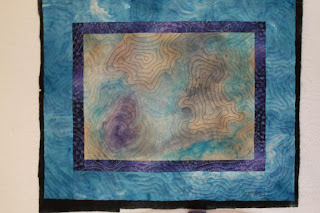
Having postponed the poppy project until I can get to London to look for my print, I tried to finish the map of the islands idea. This started as a piece of calico that I blobbed all my blue paints on, to see what they looked like, plus a purplish blue. After that I spritzed it with Mountain Mist or whatever it's called - the walnut ink one. I added a couple of borders, and left it till I got back from Wellington. I then decided to trial quilting all over the borders as well as the centre, with the same kind of lines. I wanted to get away from having separate quilting stitches for each part of the quilt. I used some 40wt variegated threads, and some metallic, and one 30 wt. Then round the three 'islands' I did some thicker thread using the bobbin. So far so good.

I obviously needed to make the island shapes more distinct, as from a distance you couldn't make them out. I used metallic oil pastels round the edge. Then I added a mixture of shiva paintsticks inside those lines. I was playing with a treasure map idea by this time. I plotted the voyage of an imaginary ship. Added a funicular to the top of one mountain, and a couple of footpaths on the other two islands, using the stitch where you have invisible in the top and coloured in the bobbin and it makes a dashed line. Had to have the top tension on 9 to make it work!

I played with beads in the centre, but again, from 3 metres you couldn't see them. I tried bigger and bolder beads, but didn't like the effect.
Since it would involve stitching at least 200 seedbeads, and I wasn't going to like the finished thing, I put all the beads back in their jars! My latest idea is to print some mappish names like Smugglers Cove onto transfer paper and label the map. Much scratching of head later, I think I am ready to put a back on it and forget the whole thing, as just a learning exercise. There are things I really like about it, and the whole map plus contour lines idea is one I think I will play with some more.

Thursday, April 23, 2009

Life since Wellington

When I had stashed away all my new purchases and had a quiet day to recover, I got back on the quilting horse. Well, I tried to. The poppy project had made a small amount of headway on the design front, but I really need a botanical drawing to continue. I researched our local library and the Christchurch one and online, but have not really found anything like I have in mind. I want the black and white anatomically correct drawing of all parts of the plant, plus preferably some text as well.

Since I have the chance to go to a Botanical Art Museum in London next month, I have iced the project for now.

Meantime I have played with a piece of handpainted fabric that I put borders on just before Wellington. I have quilted it in contour lines, and it now looks like there are 3 islands in the sea. The point of the exercise was to try to quilt over the entire piece without making the separate quilt stitching that I've always done for borders. It wasn't so hard! In fact, although I used several different topstitching threads, you can really only see the madeira fs black core metallic from a distance of 3 metres. The other threads just merge into the quilt. The next problem is to make the islands more distinct. I tried oil pastels round the edge of them, but they need more definition still. If it works out OK I have a lot of beading to add in the centre, but I won't do that until I know that the piece is worth it!

Can't add pictures right now, as Photoshop is having a bad day.

Quilted out temporarily

Two weeks have passed since my last post, during which time I went to the quilt festival in Wellington. This national event happens every other year, and sometimes in the North Island and others in the South. I had toyed with the idea of going, but when my neighbour and quilt tutor at QW, Lyn Winter, asked me to step in as room-mate, it all became a concrete plan. I registered for 5 days of classes, got accepted for 4 and then added an extra class. In addition to the classes, there were lectures every lunchtime and most evenings, by the overseas tutors. There were some well-known names, Dena Crain, Jenny Bowker, Ann Fleeton, Libby Lehman, Vikki Pignatelli and Gloria Loughman, being the ones I remember at the moment.

The venue did not compare favourably with Long Beach. No glossy conference centre, carpets etc. This was a girls' school, complete with 5 floors, several outlying prefabs, and some classes having to be held in chemistry labs etc. High stools, gas supplies on the bench etc. The one day that we were working on sewing machines, we had a normal classroom, but very cramped for 15 people, plus gear. Out of the 5 days, there was one class that stood out and that was Vikki Pignatelli's manipulating fabric. She gave a lot of examples, talked non-stop, and we got to try out a few options. They were all in her book Improvisational quilts, which I've had for a while, but it was much better to see everything in the flesh. To be honest, the other classes I took were either going over ground I already knew pretty well, or didn't cover what I imagined they would.

Don't get me wrong - I enjoyed the trip! It was so inspiring to be surrounded by people all learning, sharing and creating, and then have the exhibitions and merchants mall to look at as well. I particularly valued the chance to look through several books on my wish list. Luckily for my pocket, I decided I didn't need them at all! They were the Art quilts at play new title by Davila and Waterston, Lesley Riley's book on Lutradur, and some others I forget right now. The one I think I will buy later is Dyeing to Stitch by June Barnes.

I did buy quite a few mixed media items, like abaca paper, more Misty Fuse, burnaway, friendly plastic. There were heaps of threads which we can't get locally, so I bought several sample boxes and some variegated king tut and other threads. When I got home, there was nothing that I regretted. Well, there were a few things I had bought for classes that we didn't need at all, so that was a minor pain.

Thursday, April 9, 2009

Japanese stencils

The first time I went to Japan Noriko took me to Kyoto and we went to some small shops hidden away behind blank wooden frontages in the craft district. We went to a fantastic place that made shibori silk scarves. They were all different colours, but not the stripey looks we imagine with the term shibori. They had been stitched and sometimes multi-dyed but others were single colours. Finest silk, left with the pleating as a texture. I bought a pale peach one, to use as a summer wrap for the opera. Needless to say it's only been out of its bag twice in 5 years!


Another place we visited was an indigo dyer. They have to dye the indigo fabric up to 20 times to get the really deep blue, so it's very labour intensive, and I imagine fairly toxic. They had hundreds of used stencils of patterns they use. I think they said they were made of a rice paste, and hand cut. I've had mine in the drawer for those 5 years. I did try stencilling with paintstiks and paint a while ago, but it was only moderately successful. Today I did a couple of pulls with the stencils under a silk screen. I mixed up some yellow and a bit of red textile ink, which made a very unpleasant colour, but then added quite a bit of white and it seemed a bit like mayonnaise mixed with ketchup. However, in the pull, it looked almost metallic gold until it dried, and the colour is much nicer than it first appeared. I did one pull on the reverse of one of the leaf samples and one on polycotton.


After that I spent at least 2 hours with photoshop elements, cleaning up photos of the stencils, as I decided they were too fragile to use for screens which needed washing frequently. My plan now is to get thermofaxes made of them, which are almost indestructible. I don't know if I would seriously use them a lot, but I like the mottled effect of the chrysanthemum one, and the plum blossoms are very appealing.